
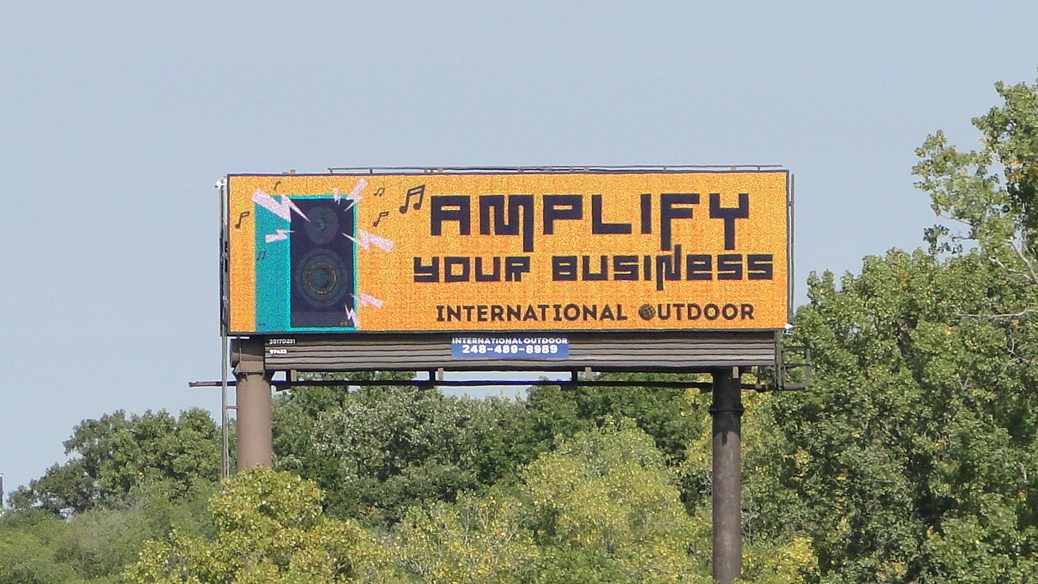
Billboards have one of the lowest CPMs of any advertising medium, making them a great source of advertising for any budget. That said, no form of advertising is free so doing your best to maximize your budget is key to your campaign’s success. But what are the best ways to maximize your campaigns value? We’ve looked at hundreds of advertising campaigns and have come up with five great ways to ensure success for any budget.
1. Identify your Goals Early
As with any form of advertising, identifying your goals before you start is the most important step when planning a billboard campaign. Without a clear plan, you leave your campaign open to a multitude of potential failures. Creating a game plan ahead of time prevents your campaign from delivering the wrong message to the wrong people at the wrong time, saving you time and money. It can also help you to more accurately measure the success of the campaign both during and after its conclusion.
2. Decide on the Best Type of Campaign
Choosing the right type of campaign can also drastically impact the power of your budget. Here at International Outdoor we offer static, digital and programmatic campaigns options. Each has its own unique benefits and can be combined to push your campaign even further.
Static billboards, also known as traditional billboards, have been around for well over a century. A static campaign utilizes printed vinyl installed on a metal frame. These types of boards are ideal for long term campaigns that require minimal copy changes. With a static campaign, the advertiser has exclusive ownership of the ad space which provides continuous exposure to the target area. Static boards are perfect for brand recognition, directional use and can include unique extensions and embellishments. While these campaigns offer constant market presence and unique creative add-on’s, their high production cost and rigidity when changing copy are potential drawbacks to consider.
Digital Billboards are computer controlled electronic displays. The space on these boards is sold in slots; typically, 8-seconds but can be as long as 30 seconds in certain instances. On a sold-out board, each advertising slot plays once every 64 seconds. Unlike Static boards, these campaigns offer no production cost and quick creative replacement. Digitals are perfect for multi-messaging campaigns whether highlighting new events, limited-time promotions, or timely announcements and can be updated in seconds. Digital campaigns also offer the ability to utilize dynamic content, including live data reporting via RSS feed. While Digital campaigns may sacrifice constant market presence, they still offer advertisers over 1,250 commercial spots every 24 hours and eliminate ad fatigue.
Flexible campaigns utilize open spaces on a complete or custom digital network to maximize reach over total plays. Since Flexible campaigns prioritize impressions over spots, they are perfect for advertisers who are looking to reach a high volume of customers over a large area. You are also not constrained to a specific board; instead, your ad can take up any available space on any available board at any available time, including the highest value boards on the network. This option is great for smaller budgets and larger reach but lacks in the location specificity that digital and static campaigns offer. You can customize your network to only include certain locations, however, since there is no guarantee that space will be available on those boards this can be somewhat limiting.
3. Pick the Right Locations
Choosing the right location is all about knowing your audience. Who are they? Where do they spend most of their time? Do they commute often? This among other questions can help you understand where you should place your ad campaign.
Understanding that your audience can frequent multiple places and identifying those areas can help you to build a sound network of boards. Choosing multiple boards not only increases reach but can also target your customers at different stages of their busy days. Say, for example, you’re a local coffee shop and you are looking to target working class people who like to drink coffee. The first board you choose could be a static near your shop that will display a directional message to create brand recognition and establish location. Then you can choose a digital on a nearby highway frequented by morning commuters that highlights a morning drink special. Lastly, you could add a third digital board leading into a working-class suburban area to help your potential audience remember your message on their way home from work. You have now connected with your audience at three points in their day in three different ways. When they’re on their way to work, when they’ve neared your business and when they’re headed home for the day. They now Know who you are, where you are and that you have a morning special, building trust and increasing their chances of coming in and making a purchase.
4. Develop Effective Creative
Developing effective creative, the is key to getting your customers to notice you and take action. Good creative creates interest, brand recognition and trust within your prospective audience so when it’s time for them to make a purchasing decision, they remember and choose you. But what makes good creative?
High Quality Imagery
Using high quality images and graphics immediately grab the viewers’ attention. Be sure to use images that are high resolution. Typically, a high-resolution image is 300 ppi (pixels per inch). Lower resolution images will display blurry or pixelated on a billboard design. Choosing large, bold visuals that can be interpreted from far away will grab the attention of onlookers and keep them interested as they get closer to the design. Be sure to choose images that clearly show a product or are relevant to your brand, company, or message.
Strong Copy
This tells your audience exactly what product, service, or message is being advertised. You want your audience to know exactly what to do and where to go after you deliver your message. Make it easy to act. Most people who see billboards are operating a vehicle. The average driver will only have about 5 to 10 seconds to read the billboard message and comprehended it so, try to limit copy to 7 words or less. Keeping the tagline catchy and memorable also improves retention and can even draw the audience to choose your brand over others.
Readable Typography
Typography isn’t just text, it’s the voice of your brand. In billboard design, good type choices can mean the difference between a powerful message and an illegible one. Choosing a good font is key to the success of your campaign. Be sure to use typefaces that are easy to read. Fancy and ornate fonts should be used sparingly, if at all. Always keep viewing distances in mind as you select type for your ad.
Color/Contrast
Contrast in design is all about creating differentiation between elements in a composition. It is achieved by bringing opposite elements together and drawing the audience’s attention to their variation. Strong color contrast is an important aspect of billboard design. The greater the contrast between the background and copy, the easier it is to read from a distance. Do your best to use dark text on light backgrounds and light text on dark backgrounds to ensure that your composition is readable from any distance.
5. Set the Right Campaign Duration
Knowing how long to run on a board is an underrated aspect of building a successful ad campaign. Cut your campaign short and you risk missing valuable potential customers but run too long and you risk burning out the market with ad fatigue. Good creative on a great board at the perfect location means nothing if your audience doesn’t see it at all or gets tired of seeing it. Ideally, you should aim for around 6-8 weeks of exposure. This gives your audience an opportunity to notice the ad, build brand recognition, and cements message recall without causing fatigue.
No two advertising campaigns are exactly alike, but following these five principles can help ensure you get the most value from your billboard budget. By identifying your goals, choosing the right campaign type, selecting strategic locations, developing effective creative, and running for the appropriate duration, you can build a campaign that delivers meaningful results. Whether you’re launching your first billboard campaign or refining an existing strategy, taking the time to plan ahead can make all the difference in maximizing your return on investment.